Two Tiaras and a Queen's Emeralds: Royal and Noble Jewels Return to Geneva
Sotheby's Royal and Noble Jewels sale in Geneva on 11 November is built on provenance: a Cartier black opal jewel made for a Duchess of Devonshire, a Mellerio tiara unaccounted for since 1957, and the emerald jewels of a Queen of Portugal.

Geneva's November jewellery week has two poles this year. Christie's has the season's great pink diamond; Sotheby's, one day later and across the same few streets, has the season's great histories. The Royal and Noble Jewels sale, live in Geneva on 11 November 2026, gathers jewels whose value sits as much in their documented pasts as in their stones, and the lots revealed so far read like a short course in how provenance is built, lost and recovered.
The catalogue essays do the persuading, and the estimates stay modest enough to let bidders write the conclusion themselves.
The Devonshire opals
The highest estimate among the revealed lots belongs to a jewel that refuses to settle into one category. Made by Cartier around 1937, it is a black opal and diamond tiara, necklace and brooch combination: five detachable brooches, each built around an oval black opal. The cutting is of its period throughout, old mine, old European and single cut diamonds with baguette accents, and a single collet set pear shaped diamond closes the front. The three central brooches can also be worn together as a devant de corsage. It is estimated at CHF 780,000 to CHF 1,100,000, and it comes in its fitted case, stamped Cartier.
Cartier made it for Mary Cavendish. She was Marchioness of Hartington at the time, and the commission most likely belongs to the coronation year of 1937, when George VI was crowned; she would later be Duchess, and then Dowager Duchess, of Devonshire. By family tradition, the black opals were presented to the Marquess and Marchioness during their official tour of Australia and New Zealand in 1936 and 1937. In 1953 the jewel appeared at a second coronation, that of Queen Elizabeth II, worn as a necklace by the Dowager Duchess, who served as Mistress of the Robes from 1953 to 1967 and walked immediately behind the Queen in the procession. It was exhibited at the Cartier exhibition at the Victoria and Albert Museum in London (12 April to 16 November 2025), and in February 2026 Emerald Fennell wore the necklace at the London premiere of her film Wuthering Heights.
The tiara that was missing for 69 years
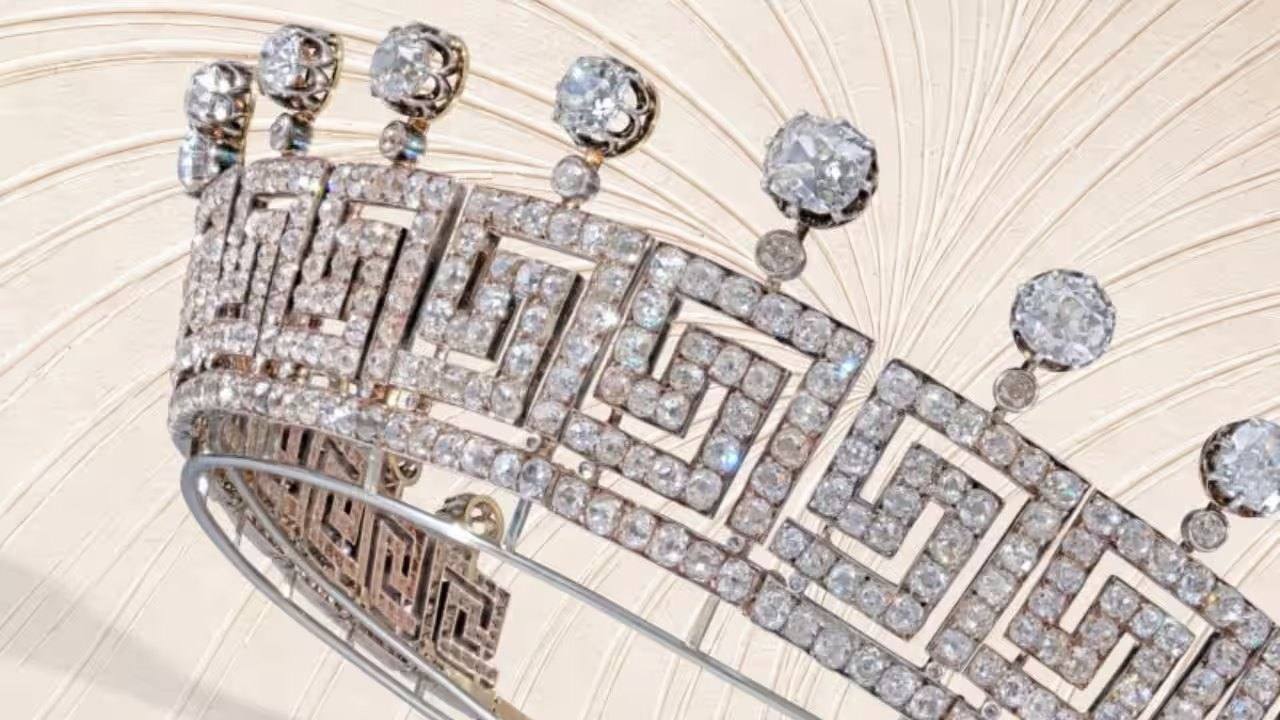
The second tiara is older, quieter and, in its way, the more remarkable survival. It was made by Mellerio dits Meller, the oldest jeweller on the Place Vendome, for the London International Exhibition of 1862, and it is built on a single idea: a band of Greek key, or meander, pattern set throughout with old mine cut diamonds and accented with rose cuts. The Greek Revival design was a direct response to Napoleon III's acquisition of the Campana collection of antiquities for the Louvre in 1861. The tiara detaches to be worn as a necklace, and carries an estimate of CHF 300,000 to CHF 500,000.
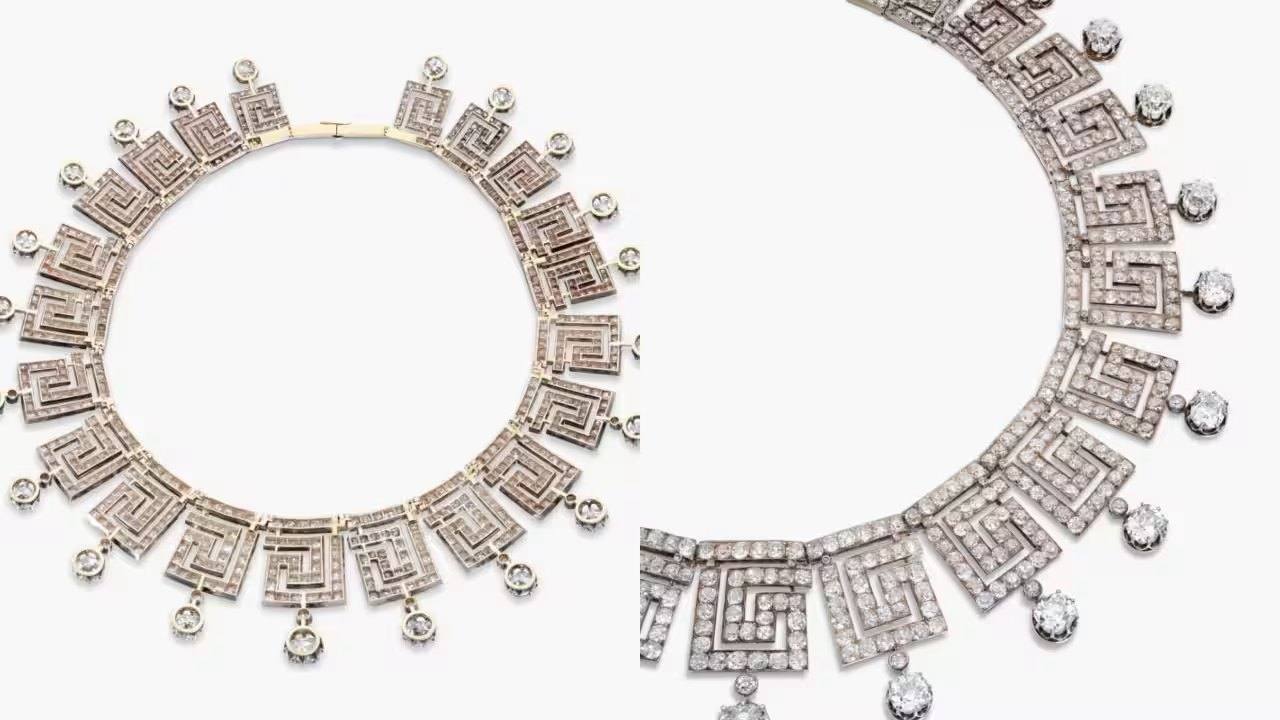
In 1864 the tiara became a wedding gift, presented by Antoine d'Orleans, Duke of Montpensier, and his wife the Infanta Louise Fernande to their eldest daughter Marie Isabelle, Countess of Paris, on her marriage to Philippe d'Orleans, Count of Paris. From her it descended through the family until 1957, when, on the death of the widowed Duchess of Montpensier, the Orléans family learned she had secretly remarried and left her estate elsewhere. The tiara disappeared from record at that point and has resurfaced only now, from a private collection, nearly seven decades later.
A queen's emeralds, a queen's necklace
Two further lots carry the Orléans story forward a generation. From Amelie of Orléans, Queen of Portugal, elder daughter of the Countess of Paris, come an emerald and diamond brooch and a matching bangle, each estimated at CHF 70,000 to CHF 100,000. The bangle's detachable centre holds a cabochon emerald of 27.38 carats inside an old mine cut diamond border and dates to the 1880s; the brooch sets a cabochon emerald in a double diamond border and suspends a detachable emerald drop. Both passed from the Queen to Princess Esperanza of Bourbon Orleans and then to Princess Maria da Gloria of Orléans Braganza, were sold at Sotheby's New York in December 1981, and appeared again at Sotheby's New York in December 1999 in the collection of Gabriele Murdock.
The Hennell pearl and diamond necklace tells a different kind of royal story, one about copies that become heirlooms in their own right. Hennell made it in 1928 for Queen Mary as a recreation of Queen Victoria's Golden Jubilee necklace, and Queen Mary gave it to her niece Mary, Duchess of Beaufort. It is estimated at CHF 120,000 to CHF 180,000. Around these headline provenances the sale adds a toi et moi ring formerly in the collection of Catherine, Lady Walston, its cabochon sapphire of 7.83 carats set against a cabochon emerald of 6.77 carats, estimated at CHF 350,000 to CHF 500,000, and, from an Italian noble family, an Adler and Bucherer necklace centred on a 43.07 carat sapphire, estimated at CHF 320,000 to CHF 480,000.
What the sale is really selling
None of these estimates is large by Geneva standards, and that is precisely the interest. Royal and Noble Jewels is the clearest annual test of what documented history adds to a jewel once the stones alone are priced. A meander tiara that slept for 69 years, opals that crossed the world as a gift of state, emeralds that survived a regicide, an exile and two previous auctions: the catalogue essays do the persuading, and the estimates stay modest enough to let bidders write the conclusion themselves. Results on 11 November will show how much of that persuasion the market still buys.
Editorial descriptions of gemstones, treatments, origins and auction results are researched to professional standards but do not replace laboratory testing, independent appraisal or authentication. See our Terms of Use.