The Bracelet That Left the Watch: Audemars Piguet's Royal Oak Joaillerie
Fifty-four years after Gérald Genta's icon made steel precious, Audemars Piguet has taken the Royal Oak's bracelet off the wrist and rebuilt it as high jewellery: nineteen pieces, three lines, no watch in sight.

The most surprising unveiling of the Paris season came from a house that makes no clothes. On 2 October 2026, during the Spring/Summer 2027 shows, Audemars Piguet presented Royal Oak Joaillerie: necklaces, chokers, cuffs and earrings built from the bracelet of its most famous watch, with no watch in any of them. The first nineteen creations fall into three lines, Dream of Joux, Risoud Eclipse and Frosted Gold, each tied to the Vallée de Joux, the valley in the Swiss Jura where the manufacture has been based since 1875.
The part of the watch that everyone touches is finally the whole of the jewel.
The spark, by the company's own account, came from the Royal Oak Mini. The idea, the manufacture's heritage team says, began with the Royal Oak Mini. Resta tried all three tiny Frosted Gold prototypes on one wrist at once, and a colleague's joke, that she was wearing them like jewellery, would not go away. The Meyrin workshops built three bracelets with no watch attached, and in November 2024 the brand brought twelve jewellery-loving women to Hong Kong for Éclat, a three-day co-creation session. Select clients saw the pieces first at events in Bangkok, Zurich and Saint-Tropez. Jewellery designer Nathalie Barzilay co-designed the collection.
The valley, set in stone
Dream of Joux is the high jewellery heart of the collection, and its centrepiece is a tie necklace in anodized blue titanium and 18k white gold. Its centrepiece sets 44 pear-shaped diamonds into the line: 42 stones of roughly a carat and a half each, plus five-carat and three-carat accents, against titanium links entirely snow-set with 1,670 blue sapphires. Eight more pear-shaped diamonds, about 15 carats together, form the matching drop earrings. The palette is the valley itself: frozen lakes, clear night skies and floral forms in deep blues, greens, pinks and solar tones, cut from diamonds, sapphires, spessartites, tourmalines, amethysts, tsavorites and topazes.
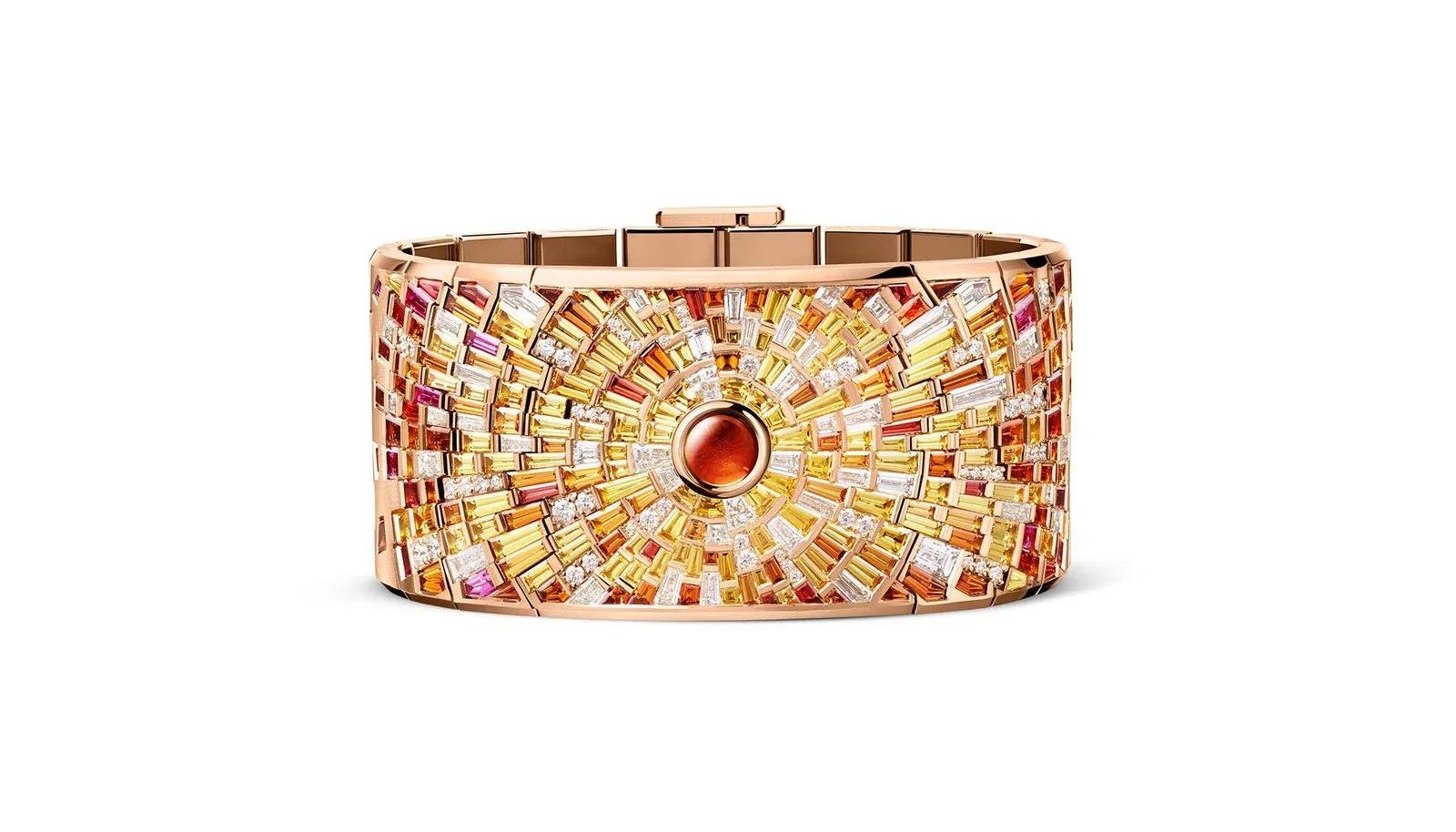
The cuffs are the line's most exuberant pieces, each one an 18k gold Royal Oak bracelet carrying a scene from the valley. Blue Moon pairs white gold with sapphires and two shades of blue topaz and is a unique piece. Frozen Lake lays diamonds, tsavorites, sapphires and topazes down as ice. Tree of Life, in pink gold, holds 203 cognac-coloured sapphires and more than 590 tsavorites. Blueberries grows a branch of yellow gold threads set with 506 leaf-shaped and brilliant-cut diamonds, 19 amethyst cabochons and 16 black spinel cabochons. Edelweiss is offered in white or yellow gold. Sunburst, unique like Blue Moon, is the boldest of them: a sunray in 18k yellow gold bursting from an orange spessartite cabochon through spessartites and yellow, orange and pink sapphires.
An eclipse in black titanium
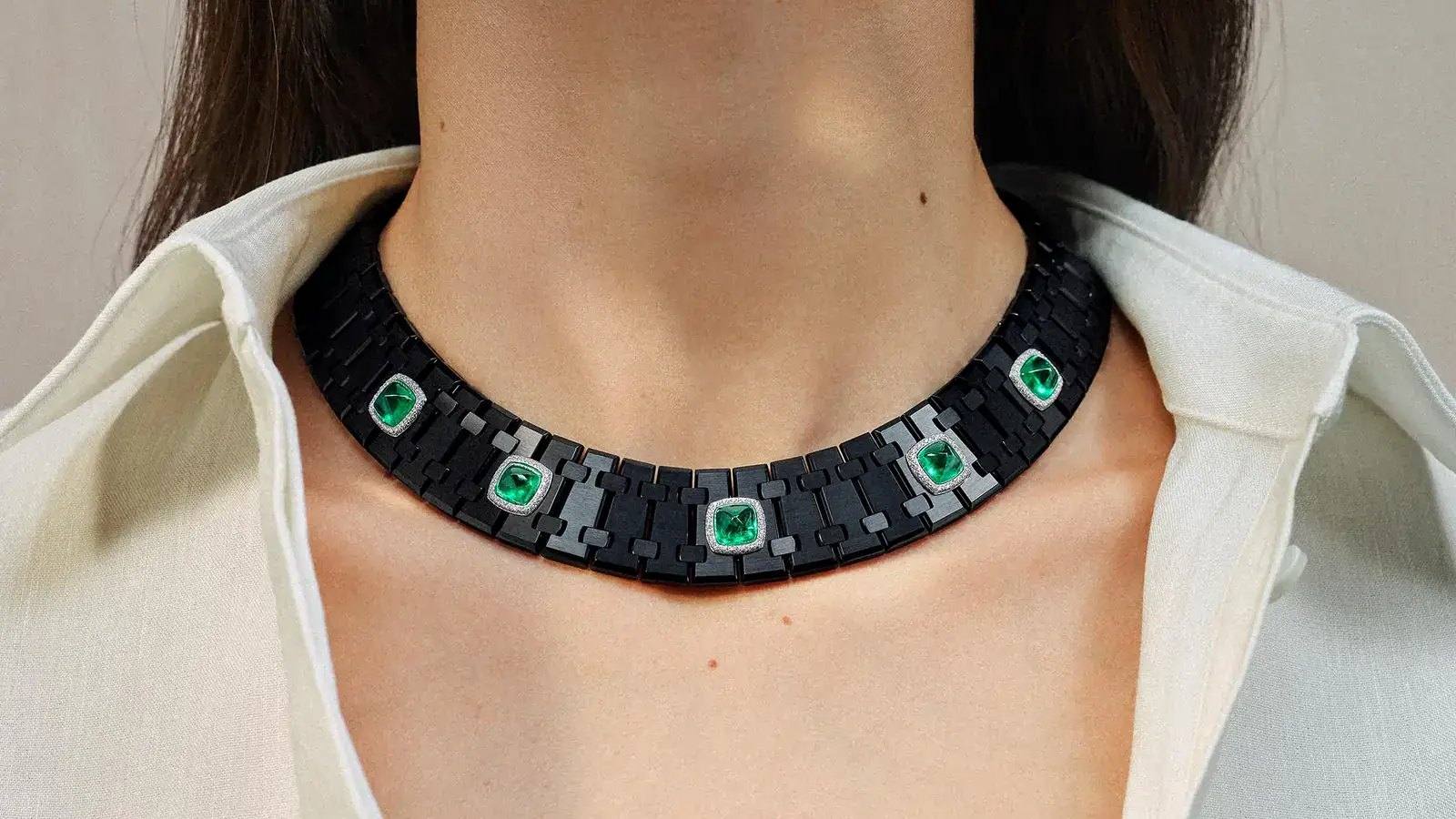
Risoud Eclipse is the dark line. Its name joins the Risoud Forest to the valley's long tradition of watching the sky, and the design imagines that forest under eclipse. Blackened titanium links and studs carry 18k white gold settings with sugarloaf emeralds, five totalling about 16.5 carats on the necklace and three totalling about 12 carats on the cuff, each ringed with brilliant-cut diamonds. The emeralds are cut with conical facets, ground and polished to admit light from every direction: the single bright thing in all that shadow.
Hammered gold
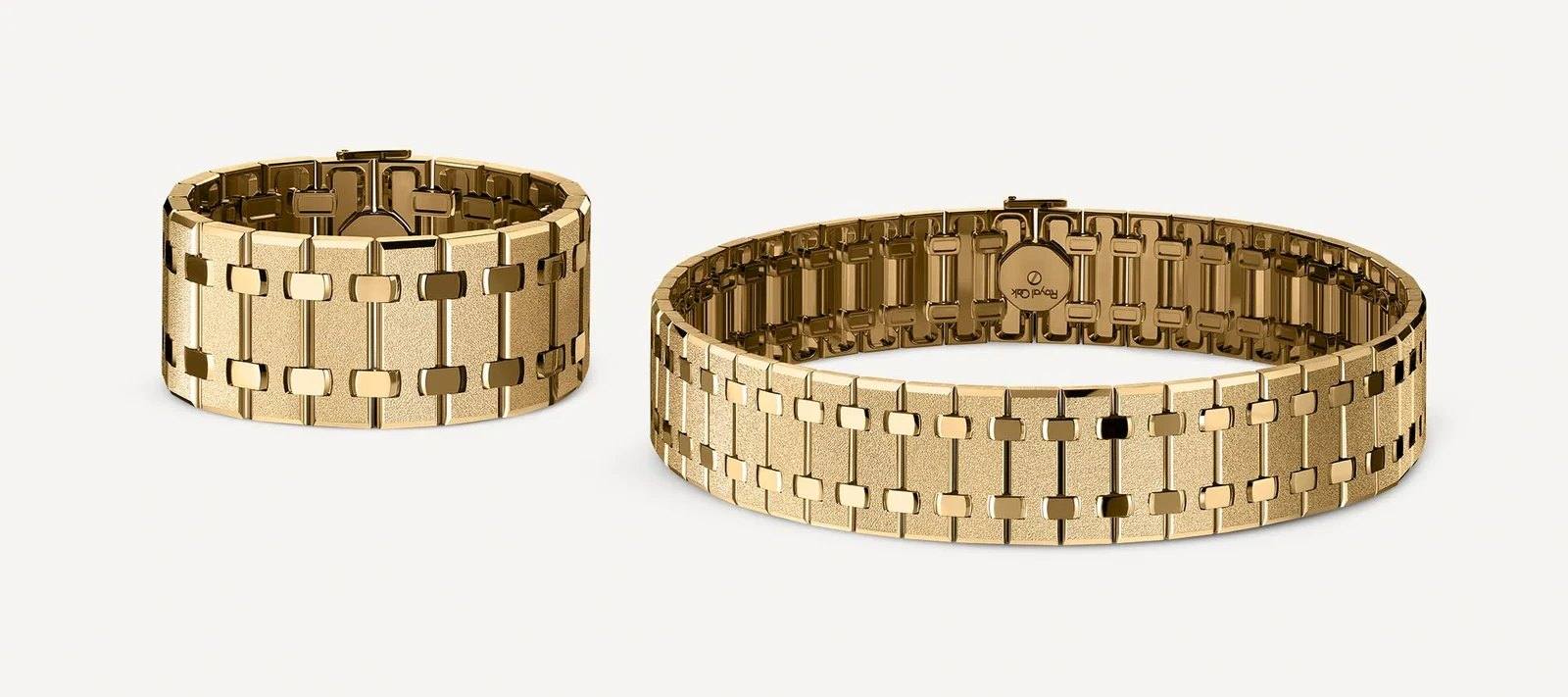
The third line, Frosted Gold, is quieter: three chokers and three cuffs in pink, white or yellow 18k gold, named Autumn Mist, Spring Frost and Summer Haze. Carolina Bucci created the finish with the manufacture in 2016 for the 40th anniversary of the women's Royal Oak, working from an old Florentine method of tapping the gold all over with a diamond-tipped hammer. Set against mirror-polished studs and chamfers, the hammered surface glitters like fine diamond dust. The pictured pieces close with the octagonal Royal Oak clasp, and these six make the collection's founding idea plainest: the bracelet, worn for itself, in a finish the clients already know from their wrists.
Fifty years of flirting with jewellery
The manufacture insists the leap is smaller than it looks, and the archive backs the claim. Long before the Royal Oak, Audemars Piguet was making pendant, brooch and ring watches with jewellers from Tiffany to Bvlgari, and a 1929 “Tutti Frutti” watch wore a gem-set case by the Parisian jeweller Egouvillon Lafon & Cie. Jacqueline Dimier, hired as the company's first in-house designer, gave the Royal Oak its women's form in 1976 and designed its first jewellery and accessories; in the 1990s her design partner Emmanuel Gueit drew a line of Royal Oak jewellery from the Offshore. An in-house jewellery workshop followed in the 1980s, then the Millenary Précieuse line, a Haute Joaillerie watch collection in 2013, and set-piece statements including the Diamond Trilogy of 2015 to 2017 and 2019's Sapphire Orbe.
The difference now is the discipline: one icon, no movement anywhere in the collection, jewellery as the entire brief. “A gateway to the past and the future, the Royal Oak Joaillerie collection embodies Audemars Piguet's free spirit,” Resta says. The house is clear that the jewellery is meant to complement the watches, not replace them: the pieces are designed to bring added value to the brand's most discerning clients. Meeting them will be a private affair. Resta has said the creations will not be offered in boutiques or sit in windows, but will be shown in intimate settings that reflect their singularity; the first presentations have run as private events rather than a conventional retail rollout. The maison has published no prices, though press reports cite a range from CHF 48,000 into the millions of dollars.
The house puts it this way: “Combining sportiness with ancestral know-how, the Royal Oak was imbued from the outset with a sensibility usually associated with jewelry.” Gérald Genta, who designed the Royal Oak in 1972, was a jewellery designer as well as a watch designer, and the Royal Oak's alternating satin brushing and polished chamfers were meant to throw light the way a diamond's facets do. For 54 years the Royal Oak argued that steel deserved the treatment of gold. Royal Oak Joaillerie makes the bolder wager: that the bracelet, the part of the watch everyone actually touches, was the jewel all along.