A Couture Repertoire: Van Cleef and Arpels Takes Its Own Measure in Geneva
Until 31 March 2027, the Van Cleef and Arpels boutique on the Rue du Rhone is showing nineteen creations from the maison's own Collection, each one an argument that jewellery begins as dressmaking: lace, belts, bows and cloth, translated into gold.

Most jewellery exhibitions borrow their splendour. This one owns it. A Couture Repertoire, which opened on 14 October 2026 at the Van Cleef and Arpels boutique at 23 Rue du Rhone in Geneva, is drawn entirely from the maison's patrimonial Collection: nineteen creations, supported by eight archival documents, chosen to make a single point the house has been making since 1906. Jewellery, at Van Cleef and Arpels, is couture by other means. The exhibition runs to 31 March 2027, entry is free and no reservation is required.
Jewellery, at Van Cleef and Arpels, is couture by other means.
Belts, buckles and the Ludo
The argument opens with the Ludo bracelet, the belt that became a jewel. The first Ludo was commercialised in 1934: a flexible mesh of polished yellow gold bricks, its pattern likened by the maison's own Collection essay to the stretcher bond used in bricklaying, the mesh produced by the metre in Italian workshops and closed by a buckle set with diamonds. It took its name from Louis Arpels, whose nickname was Ludo, and it behaved like a range rather than a single jewel, varied in stones, colours and clasp motifs from one example to the next.
Geneva shows the design mid evolution. A Ludo bracelet of 1935 keeps the brick pattern, in yellow gold with rubies, enamel and diamonds; a second, dated 1937, is in yellow gold with sapphire and diamonds. Between and around them sits a drawing of a Ludo bracelet from about 1935, one of the eight archival documents in the show, a reminder that these meshes began as lines on paper in the maison's design studio. Within a year, by 1935, the brick mesh had been joined by hexagonal units, each centred on a gem, and by mystery set surfaces of uniform colour, the direction the Collection's own Ludo hexagon bracelet of 1939 would take.
Lace, serge and the gold years
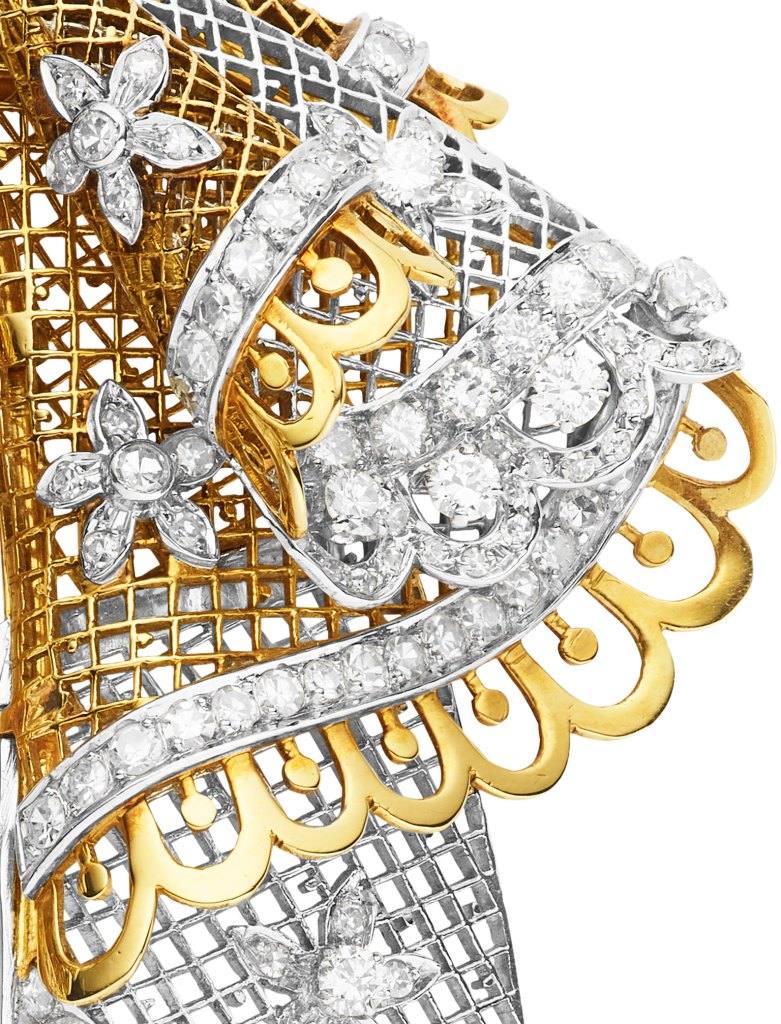
The middle of the exhibition belongs to yellow gold and to cloth. From the 1930s onward, the maison's gold work imitated textiles directly: lacework and bows, passementerie trimmings, a mesh that reinterprets serge fabric. The Belle Helene necklace of 1946, in yellow gold and platinum with rubies and diamonds, carries the post war version of the idea, and the Secret wristwatch of 1953, in yellow and white gold with diamonds, hides its dial inside a serpent link that recalls the Cadenas models of 1935: a watch dressed as a bracelet, its function kept private.
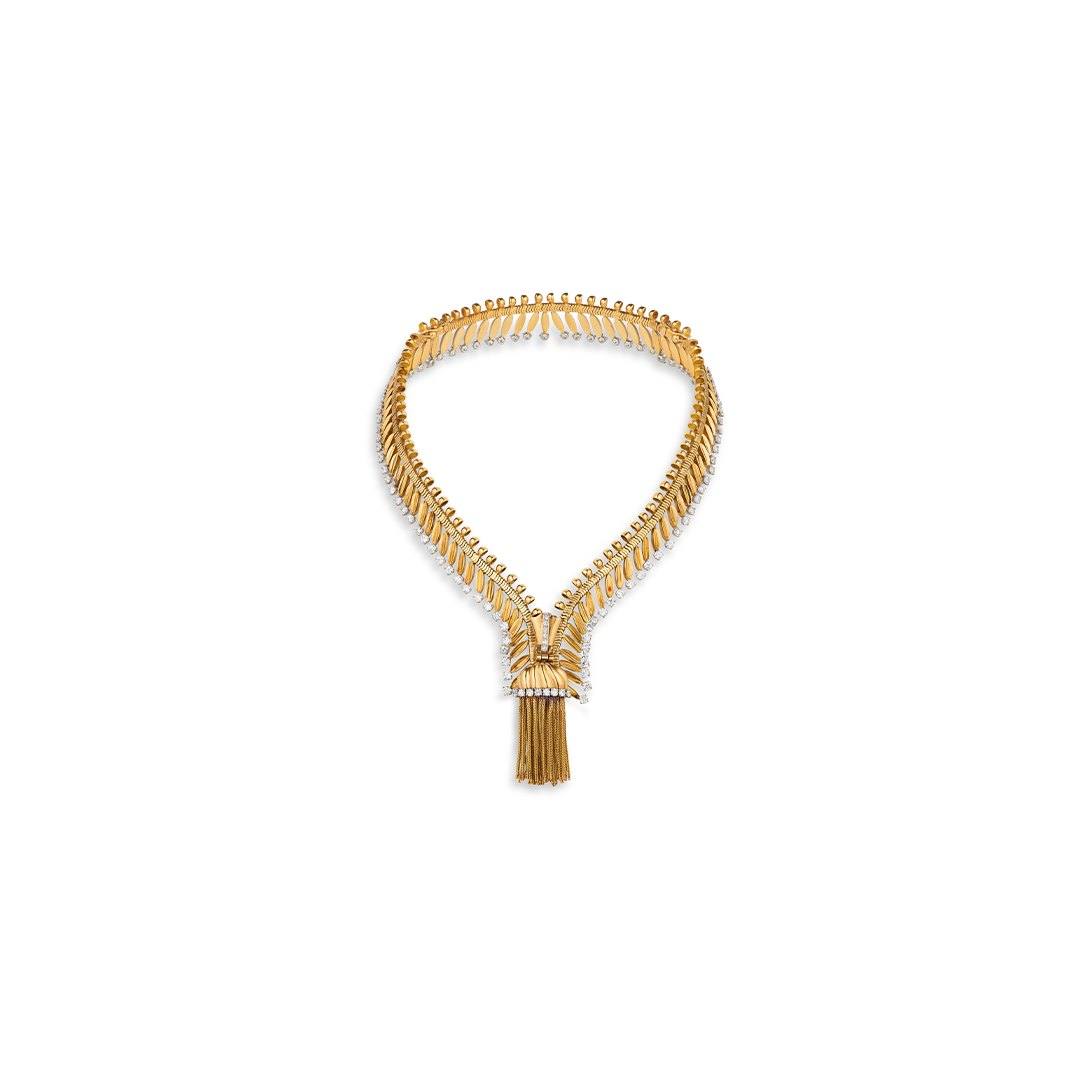
The Chaine V necklace of 1955, worked across yellow, platinum and rose gold with diamonds, closes the post war sequence. Then the palette hardens. The Philippine ring of 1971 sets onyx against diamonds in yellow gold, shown beside a drawing of Philippine rings from about 1970, and the Ribbed necklace of 1972 combines yellow gold, platinum, onyx and diamonds in the glyptic manner the maison favoured in the early 1970s. The Ribbed necklace is also the exhibition's closing argument: it transforms, becoming a bracelet with a detachable pendant, in a tradition of transformable jewels that the maison dates to 1907.
Why a boutique, why now
There is a quiet confidence in the format. No museum, no loans, no spectacle lighting: nineteen pieces in the house's own Geneva rooms, a few streets from the November auction salerooms where Van Cleef and Arpels jewels of exactly these decades will shortly be bid on with rather less serenity. The patrimonial Collection is the maison's memory of itself, and A Couture Repertoire uses it to state, in objects rather than advertising, that the house's founding idea was never only about stones. It was about how a woman dresses, and about gold that learned to behave like fabric. The exhibition is open Monday to Friday from 10 in the morning to half past six, and on Saturdays to six, until the end of March.